
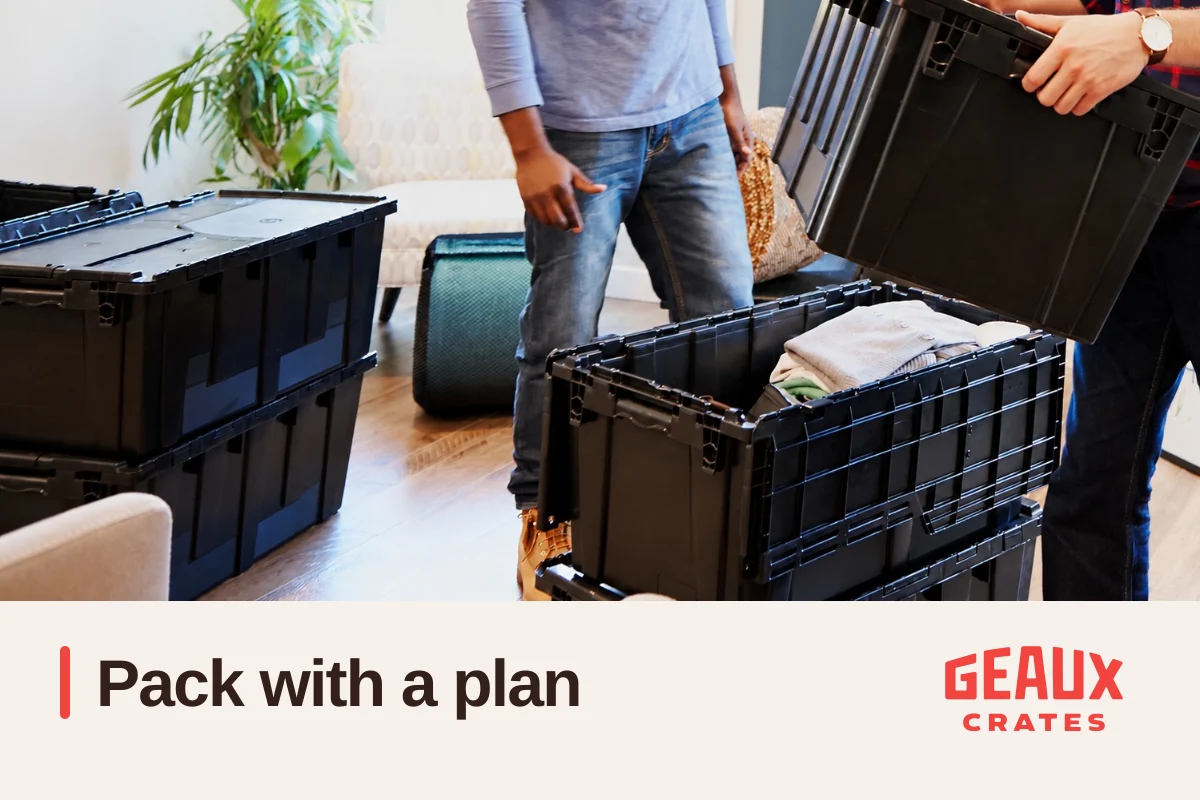
Packing a crate starts with suitable contents, cushioning, and a manageable load. Use these planning tips alongside the crate and dolly manufacturers' load, closing, handling, and stacking instructions.
1. Heavy on the bottom, light on top — within each crate
Keep heavier items from pressing on fragile contents and distribute weight according to the manufacturer's instructions. Pack heavy kitchen gear separately from delicate items where needed; weight placement alone does not guarantee stability or prevent damage.
2. Cushion contents without overpacking
Use suitable cushioning to reduce movement and contact between items. Do not force in extra contents or exceed the manufacturer's load limit just to fill the crate. A full crate is not automatically a suitable load.
3. Check closure without forcing the lid
If the attached lid does not close as intended without force, stop and check the contents and the crate before moving it. Do not force the lid shut. Follow the manufacturer's closing and stacking instructions. A lid that closes does not by itself show that the load is suitable.
4. Wrap dishes vertically, like records
For plates suited to this method, wrap each individually and pack on edge with cushioning beneath and between them. Follow guidance for your particular dishware. No packing method guarantees against breakage.
5. Bag the small stuff
Screws, bolts, remote controls, shelf pegs — every disassembled item sheds small parts. Use labeled bags, kept with the matching item or together in one clearly marked "hardware" crate. Avoid attaching tape directly to finishes that it could damage. Future-you, reassembling the bed frame at 11pm, says thanks.
6. Label by room AND priority
Every Geaux package includes moving labels — use them properly. Write the destination room big, then add a priority: OPEN FIRST (bedding, toiletries, coffee maker, phone chargers), DAY 1, or LATER. Unpacking in priority order turns chaos into a system.
7. Check heat sensitivity and transport restrictions
Check product storage and transport instructions for temperature-sensitive items, batteries, and pressurized products. Ask your mover about restricted items; putting them in a crate or car does not establish that transport is suitable. See our Houston heat guide for planning considerations.
The crate-stacking method for load day
Plan stacks using the manufacturer's instructions for the specific crates and dolly, the load weights, and the surface or vehicle involved. Arrange suitable restraint for transport. Loading time depends on the route, contents, equipment, and help available.
What not to do
- Don't overfill past the lid. (See rule 3. It's worth repeating.)
- Don't mix rooms in one crate unless it's the last few items. Keeping rooms together can make contents easier to find.
- Check liquids before packing. Follow product and mover requirements, close containers properly, and use suitable secondary containment to reduce leaks.
- Spread heavy items across suitable loads. Follow the crate and dolly manufacturers' load and handling instructions.
Use the checklist to plan, then adjust for your belongings and the equipment instructions.
Need the crates first? Pick your package — 10 to 100 crates with dollies, and delivery and pickup across our Houston service area — the first 15 miles of each trip are included, then a $2/mile distance charge applies. Questions: (888) 615-2699.
Ready to Geaux?
Check availability for your dates in under a minute.
GET MY CRATES →(888) 615-2699